English
Practical Challenges and Solutions (Part I):
Analysis of Drinking Water, Surface Water, and Groundwater
In the field of ion chromatography, regarding the latest standard HJ 1470-2026 "Water Quality - Determination of Chromium (VI) - Post-column Derivatization / Ion Chromatography", what practical difficulties might we encounter during actual operations, and how should we address these challenges? Let's hear the answers from our senior application engineer:
Low standard limits: Surface Water Class I ≤ 0.01 mg/L; Groundwater Class I/II ≤ 0.005 / 0.01 mg/L; Drinking Water ≤ 0.05 mg/L.
The new standard HJ 1470-2026 provides three reference conditions, but the performance of low-concentration samples varies drastically under different conditions.
When dealing with water bodies at the μg/L or even sub-μg/L level, what experimental details must be attended to during the process to ensure data stability and reliability?
pH Value: Hexavalent chromium is easily reduced to trivalent chromium under acidic conditions (pH < 4). Therefore, water samples must be adjusted to pH 8–9 using a sodium hydroxide (NaOH) solution immediately after collection.
Container Material: It is recommended to use polypropylene (PP), polyethylene terephthalate (PET), or higher-grade fluoropolymer vessels (such as PFA) throughout the entire experimental process, including sampling. Avoid using glassware, as glass may leach trace amounts of hexavalent chromium, leading to false positives.
Preservation Time: Following pH adjustment, samples must be refrigerated at 4°C and analyzed within 7 days.
Membrane Material: Aqueous microporous filtration membranes made of polyethersulfone (PES) or hydrophilic polytetrafluoroethylene (PTFE) are recommended.
Membrane Specification Selection: Adhere to the standard method by using a 0.22 μm pore size where possible. Compared to a 0.45 μm membrane, a 0.22 μm membrane can retain finer particulate matter, effectively preventing chromatographic column clogging.
Critical Step: Every new batch of filtration membranes must undergo a blank verification test after filtering ultrapure water. If the concentration of hexavalent chromium in the filtrate exceeds the method detection limit (MDL), the brand or batch must be replaced immediately.
The background levels of hexavalent chromium can vary significantly among different brands, and even across different batches from the same brand. Under no circumstances should the "membrane blank verification" step be omitted.
The interference elimination methods provided in the HJ 1470-2026 standard primarily rely on dilution or passing through cleanup cartridges. However, these two approaches are not entirely applicable to drinking water, surface water, and groundwater:
Dilution: The analyte concentrations in these water samples are already close to the detection limits of conventional instruments. Dilution often pushes the concentrations directly below the detection limit, making accurate quantitation impossible. Nevertheless, as a precaution to protect analytical instruments, it is highly recommended to perform an initial semi-quantitative/quantitative screen at a higher dilution factor for samples with unknown concentrations, and then progressively determine the optimal dilution ratio.
Cartridge Cleanup: Cleanup cartridges may introduce fresh contamination or interferences, while simultaneously increasing pre-treatment steps and operational costs. Therefore, if a cleanup step must be employed, a blank check on the cleanup cartridge is required beforehand.
How does Prin-Cen address the aforementioned challenges?
High-Performance Ion Chromatography Pump with Dual-Motor Independent Drive:Features extremely low pulsation and high flow rate precision to guarantee the stability of analysis results.
TLD Ultra-High Sensitivity, Ultra-Strong Anti-Interference Detector: Constructs a detection capability as low as the 5 ppt (0.005 μg/L) level.
Exclusive ONLY WATER KIT™ Toolkit: Truly enables a "plug-and-play" experience, eliminating all the hassles and worries mentioned above.
Stable Detection After Dilution: While conventional instruments fail to detect target analytes after dilution, Pro-Lysis—backed by powerful hardware performance—ensures stable detection even after dilution. Interferences can be eliminated through simple dilution alone, eliminating the need for column clean-up without sacrificing sensitivity.
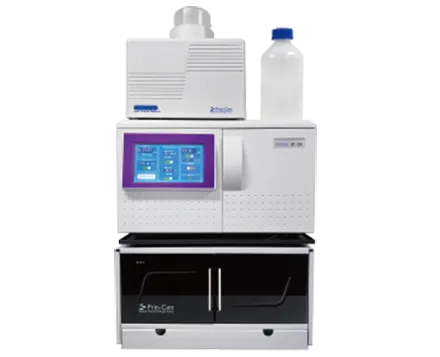
Ion Chromatograph: Ultra-trace hexavalent chromium analyzer
Detector: Pro-Lysis TLD detector
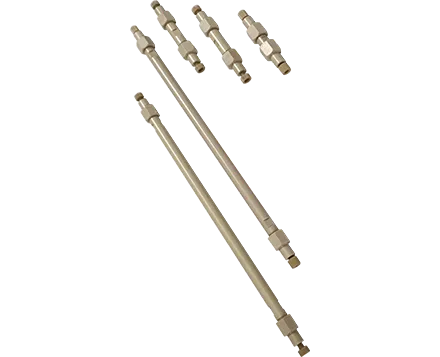
Chromatographic Column: PrinCen-Cr(VI) Fast Column (50 mm × 4 mm)
Eluent and Derivatization Reagents: Pro-Lysis ONLY WATER KIT series reagent kits
Standard Reference Material: Hexavalent chromium standard stock solution (100 mg/L), diluted progressively before use
Parameter | Set Value |
Eluent Flow Rate | 1.2 mL/min |
Derivatizing Agent Flow Rate | 0.70 mL/min |
Mixing Coil Volume | 486 μL |
Detection Wavelength | 540 nm |
Column Temperature | Room temperature (approx. 25°C) |
Prin-Cen Advantage: Peaks elute within 3 minutes,
delivering an analysis efficiency 2 to 3 times higher than other reference conditions.
Collection and Preservation: Collect at least 100 mL of sample using a polypropylene (PP) plastic bottle. Immediately adjust the pH to 8~9 using sodium hydroxide solution (4 g/L) or hydrochloric acid solution (1 mol/L). Store under refrigeration at 4°C and complete the determination within 7 days.
Filtration: Filter the sample through a 0.22 μm aqueous microporous membrane filter (the filter must undergo a blank test before use).
Direct Injection:Transfer the filtered sample into an autosampler vial and mount it on the instrument for analysis.
Pro-Lysis Advantage: Most clean water samples only require filtration before direct injection, eliminating complex pretreatment steps. With the supporting ONLY WATER KIT™ reagent kit, users only need to dilute with ultra-pure water for true out-of-the-box convenience.
A 0.1 μg/L hexavalent chromium standard solution yielded a peak height of up to 3705 μAU, exhibiting a sensitivity more than 10-fold higher than that of conventional IC-UV/Vis.
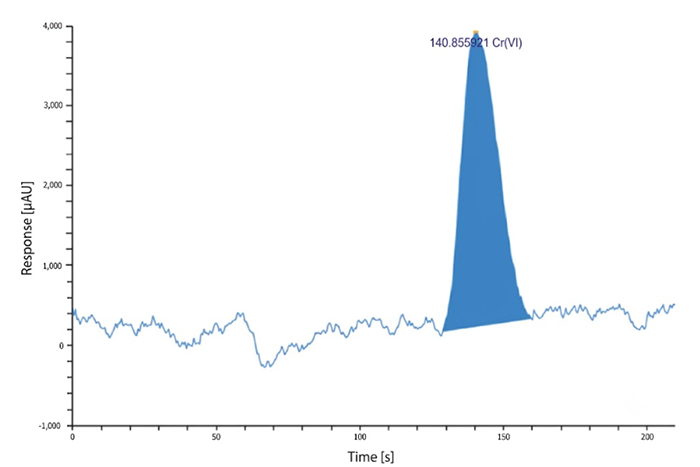
Chromatogram of 0.1 μg/L hexavalent chromium
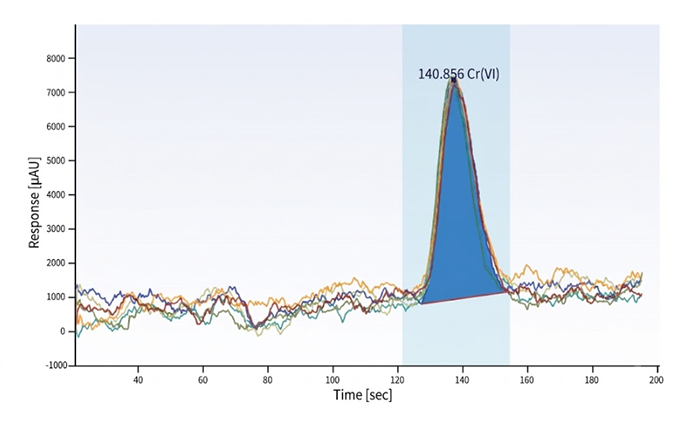
The standard solution of hexavalent chromium at 0.2 μg/L was measured seven times in parallel. The RSD of retention time was 0.22%, and the RSD of peak area was 1.52%, indicating favorable precision of the method.
Replicate No. | Retention time (s) | Concentration (μg/L) | Peak area (μAU·s) |
1 | 141.2 | 0.2034 | 80815 |
2 | 140.9 | 0.2044 | 81611 |
3 | 141.0 | 0.2030 | 80525 |
4 | 141.2 | 0.2037 | 81055 |
5 | 140.7 | 0.2004 | 78588 |
6 | 141.7 | 0.2003 | 78443 |
7 | 141.1 | 0.2024 | 80091 |
Average | 141.1 | 0.2025 | 80166 |
SD | 0.3132 | 0.0016 | 1217 |
RSD | 0.22% | 1.56% | 1.52% |
Chromatograms and corresponding test data obtained from seven replicate measurements
of 0.2 μg/L hexavalent chromium standard solution